





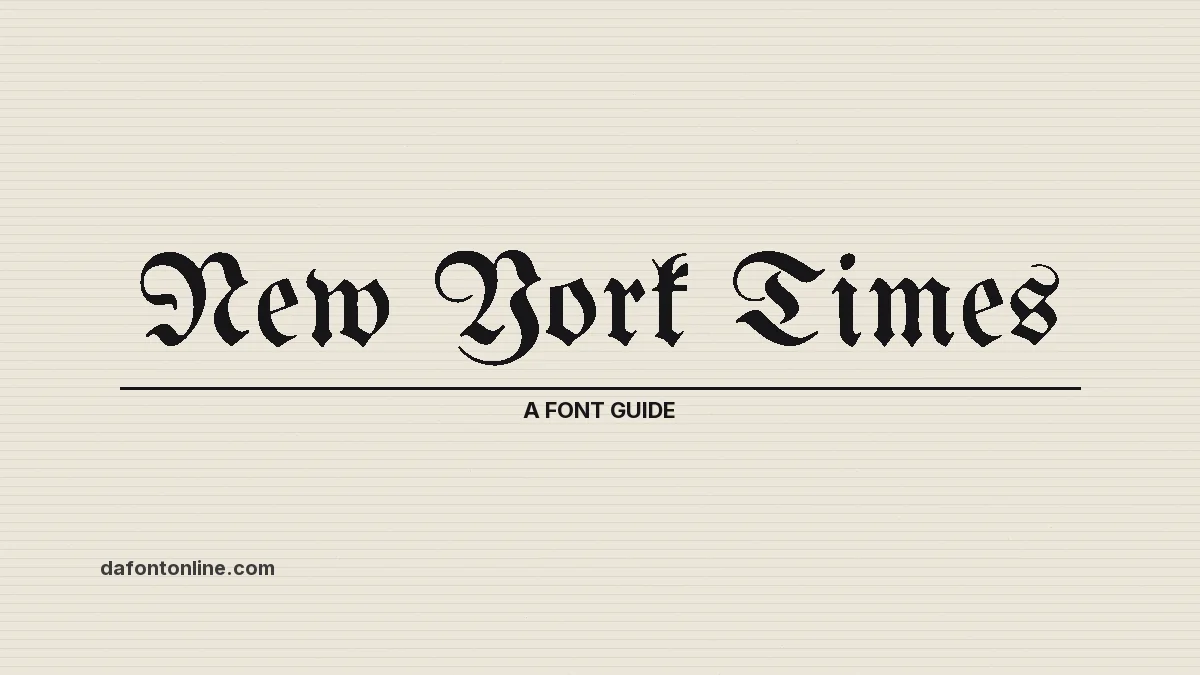
Quick answer: The New York Times nameplate has no published font name, and the paper’s own faces aren’t for general licensing. UnifrakturMaguntia is the closest free blackletter, and six free matches are listed below.
On this page
- 01 Download the free look-alikes
- 02 Element map: which font goes with which part
- 03 The nameplate: blackletter, with no published name
- 04 How the name changed
- 05 NYT Imperial: the body face you can’t download
- 06 Cheltenham and Franklin in the paper
- 07 Not the one you mean?
- 08 Questions about the New York Times font
- 09 Before you go
Download the free look-alikes
UnifrakturMaguntia is a blackletter that comes closest to the masthead’s feel. Libre Franklin is a Franklin-style grotesque for headlines and labels, and Libre Caslon Text is a sturdy text serif for body copy. Each card shows its licence, and each group says why its fonts are here.
Masthead blackletters
The nameplate is blackletter. UnifrakturMaguntia is the closest of these to its feel, and Olde English and Blackletter are look-alikes in the same family.
-
UnifrakturMaguntia Download font Open in Studio
- Format
- TTF
- Licence
- Free for commercial use
- Made by
- j. 'mach' wust
- Source
- fonts.google.com
New York Times -
Olde English Download font Open in Studio
- Format
- TTF
- Licence
- Free for commercial use
- Made by
- Dieter Steffmann
- Source
- www.dafont.com
New York Times -
Blackletter Download font Open in Studio
- Format
- TTF
- Licence
- Free for commercial use
- Made by
- Dieter Steffmann
- Source
- www.dafont.com
New York Times
Type the masthead below in black on newsprint and download it as a PNG.
Made with the free UnifrakturMaguntia font (open license), styled to look like New York Times. Fan-made style; not an official logo.
Body and sans
NYT Imperial and NYT Franklin are custom faces that aren’t for general licensing. Libre Caslon Text is a free text serif for body copy, and Libre Franklin is a Franklin-style grotesque for headlines and labels.
-
Libre Franklin Download font Open in Studio
- Format
- TTF
- Licence
- Free for commercial use
- Made by
- Impallari Type
- Source
- fonts.google.com
New York Times -
Libre Caslon Text Download font Open in Studio
- Format
- TTF
- Licence
- Free for commercial use
- Made by
- Impallari Type
- Source
- fonts.google.com
New York Times
Captions and labels
Old Newspaper Types has a typewriter-style, printed-page feel that suits captions and labels.
-
Old Newspaper Types Download font Open in Studio
- Format
- TTF
- Licence
- Free for commercial use
- Made by
- Manfred Klein
- Source
- www.dafont.com
Caption


Element map: which font goes with which part
The paper has several typefaces, and most are custom. This table lists each part and the closest free font we host. Where a face has no free match on this page, the table says so.
| Element | Official font | Look-alike we host (licence) |
|---|---|---|
| Nameplate | Blackletter, no published name | UnifrakturMaguntia (OFL); Olde English, Blackletter (free for commercial use) |
| Headlines | NYT Cheltenham (custom, Carter & Cone) | None hosted |
| Body text | NYT Imperial (custom, not for general licensing) | Libre Caslon Text (SIL OFL) |
| Sans | NYT Franklin (custom, Carter & Cone) | Libre Franklin (SIL OFL) |
The nameplate: blackletter, with no published name
The paper says its nameplate is built on blackletter, or Gothic, letterforms, a style that predates printing by centuries. That tells you the family, not the exact face. The paper’s own explanation is in its 2017 article on the nameplate. People most often point to Engravers’ Old English, a blackletter that the American Type Founders’ foundry released in 1901. We are not saying it is the nameplate. It is the closest name people already use, so we list it as a look-alike only.
How the name changed
The paper started on 18 September 1851 as the New-York Daily Times, and its founder, Henry Jarvis Raymond, took as his model the British paper The Times, which used a blackletter style called Textura, according to Wikipedia. The name was shortened to The New-York Times on 14 September 1857. The hyphen went after Adolph Ochs bought the paper in 1896. The logo you see today dates from 21 February 1967, when type designer Ed Benguiat redrew it and dropped the full stop that used to follow Times. The two side by side show how much the lettering has changed in a century.


NYT Imperial: the body face you can’t download
Searchers often ask for NYT Imperial, the paper’s body text face. Fonts In Use calls it custom work by Matthew Carter for the paper, dated 2007, and notes that it isn’t licensed for general use. So we name it and don’t host it. If you need a body serif for your own page, Libre Caslon Text is a free, sturdy text face. It is not Imperial and doesn’t copy it.
Cheltenham and Franklin in the paper
The paper’s headlines use a custom NYT Cheltenham. Cheltenham itself was designed in 1896 by Bertram Goodhue and Ingalls Kimball and released by American Type Founders in 1903. NYT Cheltenham, like NYT Franklin, is a custom version by Carter & Cone, so we name both and host neither. For a Franklin-style sans, use Libre Franklin from the download above.
Not the one you mean?
New York is also the name of Apple’s serif, made for Apple platforms under Apple’s licence. Apple offers it to developers for designing apps on its own platforms, under Apple’s licence, and it has nothing to do with the paper’s lettering.
Questions about the New York Times font
What font does the New York Times use?
The nameplate is blackletter lettering with no published font name. Inside the paper, the body text is the custom NYT Imperial and the headlines use a custom NYT Cheltenham. Neither is offered for general licensing.
What is the New York Times font called?
The body face is usually called NYT Imperial, by Matthew Carter for Carter & Cone. The nameplate has no published name.
Is there a free New York Times font?
There is no official free version. UnifrakturMaguntia is a free blackletter look-alike for the masthead, and Libre Caslon Text and Libre Franklin cover body text and sans headlines.
Is the New York Times font copyrighted?
The paper’s custom faces are not for general licensing, so don’t use them. The free matches on this page each show their licence on the card: UnifrakturMaguntia and the Libre fonts are open source, and the dafont fonts are marked 100% free by their makers.
Before you go
For the masthead look, start with UnifrakturMaguntia. For text, Libre Caslon Text is a comfortable choice. If you want the classic newspaper serif that many papers have leaned on, the Times New Roman font page is the next stop.